An Overview of Hyperledger - The Leading Enterprise Blockchain Platform
Table of Contents
Abstract
Hyperledger is an open-source collaborative effort created to advance cross-industry blockchain technologies. Hosted by The Linux Foundation, Hyperledger aims to develop a comprehensive suite of stable frameworks, tools, and libraries suitable for enterprise-grade blockchain deployments. It is widely recognized as a leading platform for building permissioned blockchain applications geared toward enterprise use cases.
According to Brian behlendorf, executive director of Hyperledger
“Hyperledger is an open source community of communities to benefit an ecosystem of hyperledger based solution providers and users focused on blockchain related use-cases that will work on variety of industrial sectors”
Why?
When blockchain first appeared, most attention focused on public networks like Bitcoin and Ethereum. These systems are open to everyone and built for transparency — but they don’t fit business needs very well.
Industries such as finance, supply chain, and manufacturing need networks where only authorized members can join, where data privacy is protected, and where transactions can be fast and verified among trusted parties.
To solve this, the Linux Foundation launched Hyperledger in 2015 as a global, open-source collaboration. Its goal is to create modular and permissioned blockchain frameworks that companies can use to build secure, private, and scalable solutions without needing a public cryptocurrency.
Design Principles
Hyperledger projects are built on clear philosophy: They focus on solving real business problems that require strong security, privacy, and system integration. In enterprise environments, companies often deal with sensitive data and need to control who can access information. Hyperledger follows design principles that make blockchain technology suitable for these needs.
This means each project is developed with features like permissioned networks, modular architecture, and tools that help organizations connect blockchain with their existing IT systems.
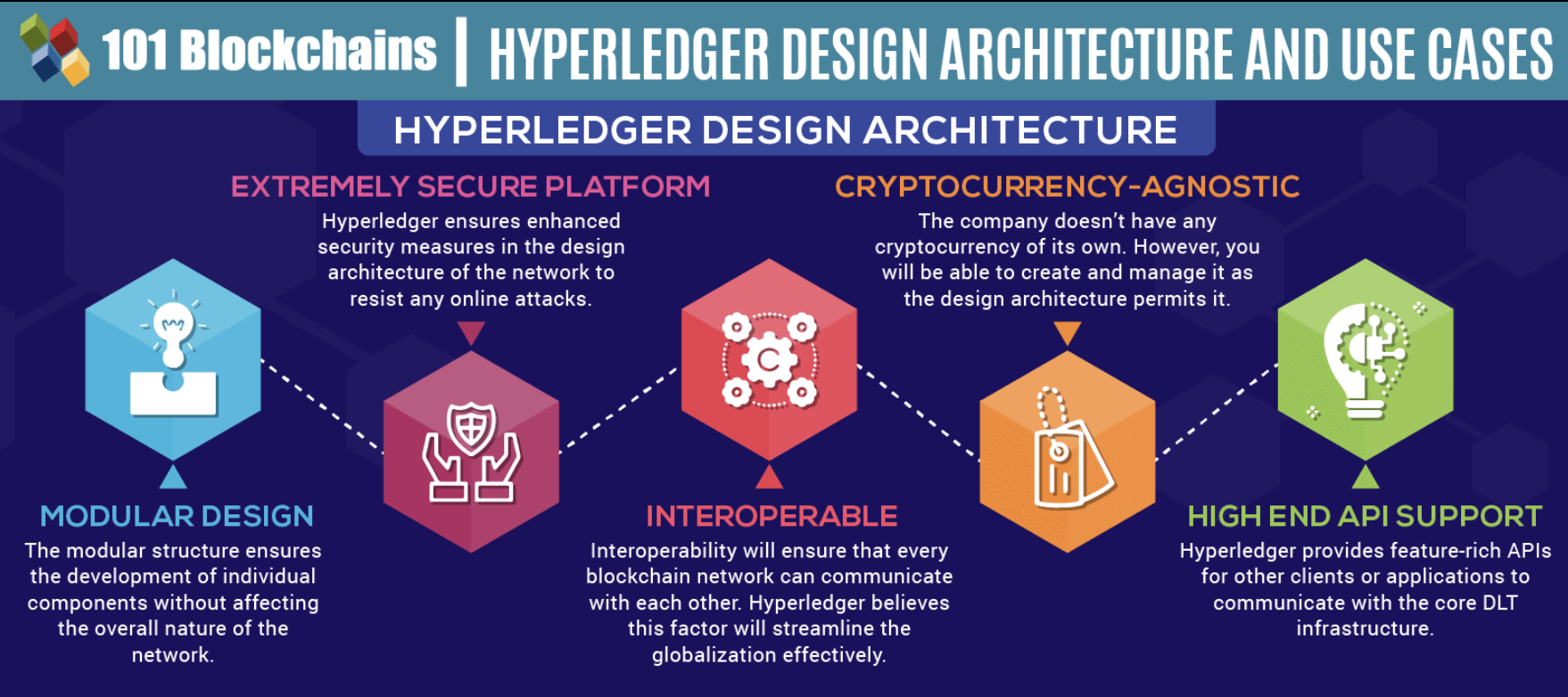
Hyperledger Design Architecture
Modular Architecture: Hyperledger provides a modular design that enables developers to customize and integrate different components, such as consensus mechanisms, membership services, and ledger storage. This architecture allows for components to be used interchangeably based on specific use cases.
Permissioned Network: Hyperledger focuses on permissioned blockchain networks, where all participants are known and must be authorized to join. This approach enhances trust and security among participants
Security and Confidentiality: Given that blockchain data is often immutable, Hyperledger emphasizes a high level of security and robustness. The architecture is designed for confidentiality, which is particularly vital for enterprise applications requiring restricted data visibility
Non-Cryptocurrency Architecture: Unlike public blockchain projects, the design of Hyperledger does not incorporate cryptocurrency token
Interoperability: The platform is designed to be interoperable, allowing its applications to connect and interact with blockchain applications built on other platforms, such as Ethereum
Ecosystem
The Hyperledger ecosystem consists of various projects categorized into Distributed Ledger Frameworks, Tools, and Libraries
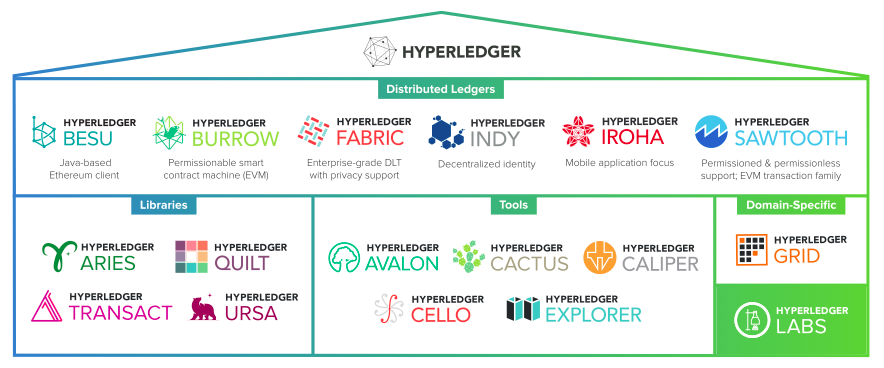
The Hyperledger Project umbrella - An overview of Hyperledger blockchain technologies and their uses paper
Hyperledger Fabric
The most widely adopted framework, Fabric provides a modular and secure architecture suitable for enterprise-grade applications. Key features:
- Permissioned membership using MSP (Membership Service Provider)
- Pluggable consensus (e.g., Raft, Kafka, or BFT)
- Chaincode (smart contracts) written in Go, Node.js, or Java
- Channel-based data partitioning for privacy
Use cases: Supply chain tracking, trade finance, digital identity.
Hyperledger Sawtooth
Originally developed by Intel, Sawtooth focuses on flexibility and scalability. Notable feature: Proof of Elapsed Time (PoET) — a consensus algorithm optimized for trusted execution environments (TEE).
Use cases: IoT integration, logistics, and data provenance
Hyperledger Besu
An Ethereum-compatible client designed for both public and private network use.
- Supports EVM and smart contracts using Solidity
- Allows enterprises to bridge public and private ecosystems
Use cases: Consortium blockchains and DeFi integrations.
Hyperledger Indy
Specialized for decentralized identity (DID) solutions.
- Built-in support for verifiable credentials
- Interoperable with W3C standards
Use cases: Self-sovereign identity, KYC, credential verification.
Hyperledger Iroha
A simple, efficient blockchain platform focusing on mobile and infrastructure integration.
- Emphasizes ease of use and role-based permissioning
- Ideal for applications with simple asset management logic
Ethereum vs Hyperledger
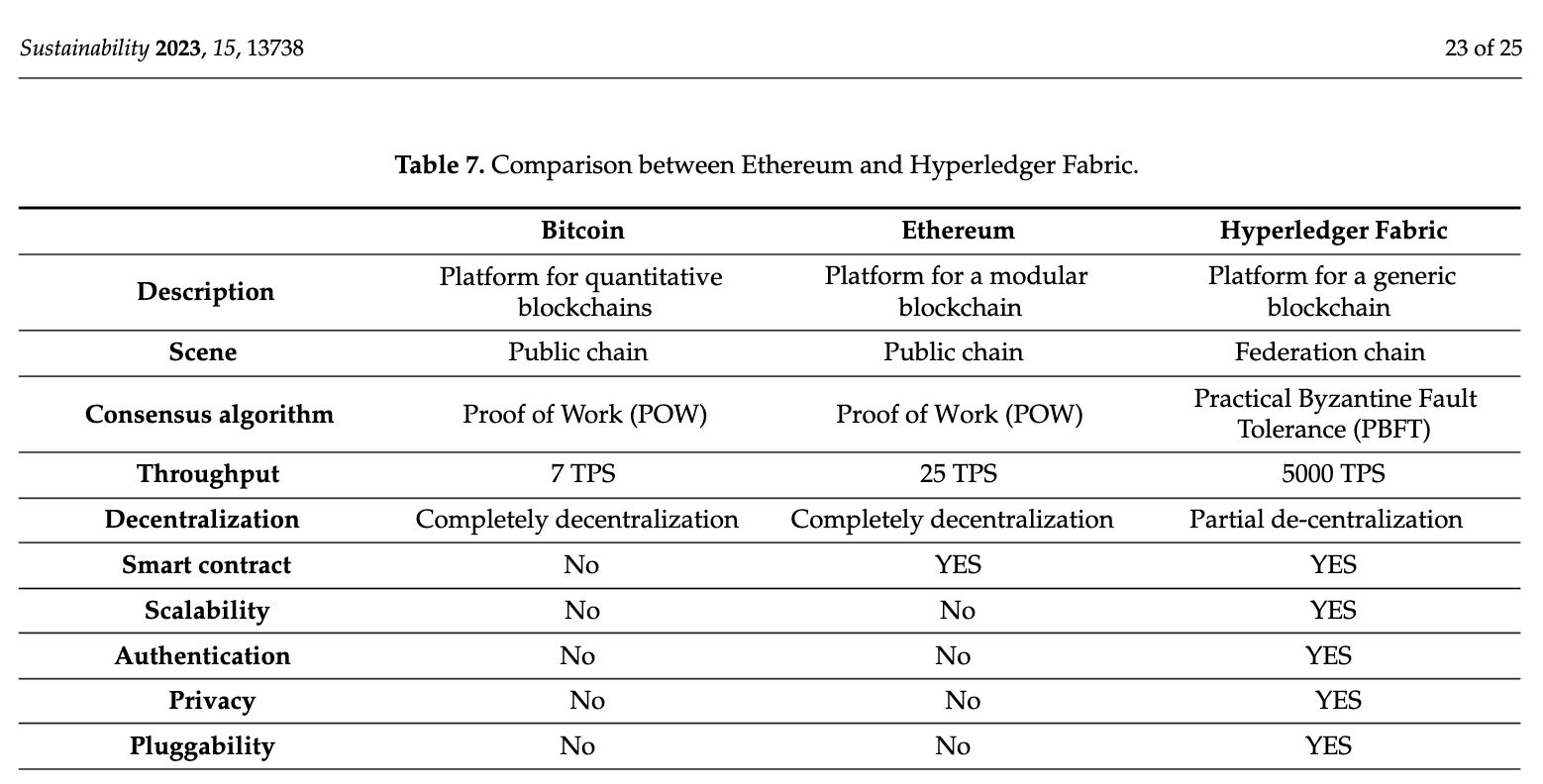
Hyperledger Fabric-Based Tea Supply Chain Production Data Traceable Scheme
Hyperledger Architecture
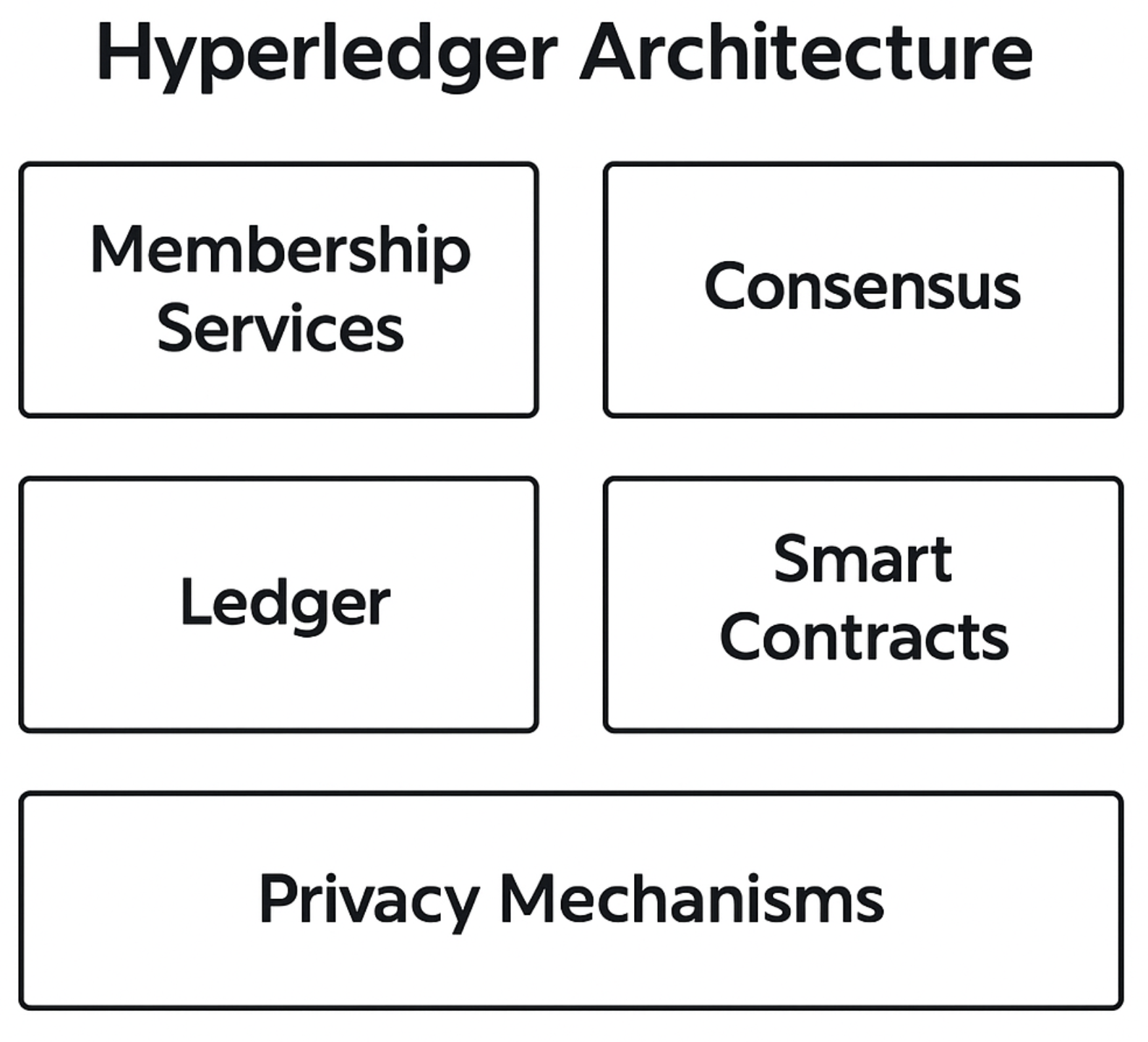
Architecture
The general architecture across frameworks includes:
- Ledger: Keeps a permanent record of all transactions that can’t be changed.
- Smart Contracts (Chaincode in Fabric) Define the business rules and automatically execute them on the blockchain. ()
- Privacy: Protects sensitive data and controls who can see what information.
- Consensus: Makes sure all members in the network agree on the same version of the ledger.
- Membership Services: Manages the identities of people and organizations in the network.
This modularity allows organizations to customize blockchain components according to their operational and regulatory needs.

Main components of a single node Hyperledger fabric network (uploaded by Josep M. Guerrero)
Real-World Applications of Hyperledger
Below are real-world applications that show how Hyperledger, especially Hyperledger Fabric, is transforming industries today.
Walmart & IBM — Food Supply Chain Transparency
Walmart teamed up with IBM to use Hyperledger Fabric for tracking the origin of food products such as mangoes in the U.S. and pork in China. → Result: The time to trace a product’s source dropped from seven days to just 2.2 seconds, dramatically improving food safety and recall efficiency.
Circulor — Responsible Mining and Battery Materials
Circulor uses Hyperledger Fabric to trace raw materials like cobalt and lithium used in electric vehicle batteries. → Result: Ensures ethical sourcing and compliance with global standards, building consumer trust and corporate accountability.
Sony Global Education — Verifiable Digital Credentials
Sony Global Education developed a blockchain-based platform using Hyperledger to issue and verify academic certificates. → Result: Students and institutions can instantly verify credentials, reducing fraud and administrative overhead.
Change Healthcare — Transparent Medical Claims
In the healthcare sector, Change Healthcare implemented Fabric to streamline claim management and improve transparency. → Result: Faster claim resolution, better interoperability among providers, and a trusted audit trail.
IBM Blockchain Platform — Multi-Industry Blockchain-as-a-Service
IBM’s Blockchain Services, built on Hyperledger Fabric, offer enterprise solutions for logistics, finance, identity, and healthcare. → Result: Thousands of organizations can deploy custom blockchain networks without managing complex infrastructure.
Conclusion
Hyperledger has emerged as a key framework for enterprise blockchain adoption, providing modular, permissioned, and scalable solutions across industries. Its open governance and strong community collaboration enable continuous improvement and ensure enterprise-level reliability. Real-world implementations such as IBM Food Trust, TradeLens, and Energy Web Foundation demonstrate its practical value in building trusted, transparent business networks. As blockchain technology extends beyond cryptocurrency, Hyperledger remains a driving force in shaping the future of enterprise innovation.
What’s Next?
Now that we understand the basic ideas of Hyperledger, our next step is to dive deeper into its core components. In the upcoming lesson, we’ll explore Hyperledger Fabric Architecture — and learn how key elements like the ledger, smart contracts (chaincode), membership services, and consensus mechanisms work together to build a complete blockchain network.
By mastering these building blocks, you’ll gain a clearer view of how enterprise blockchain systems are structured and how they operate in the real world.
Wishing you a happy day! Catch you later ^^
Posts in this Series
- What Is Blockchain
- The Fundamental Concepts of Blockchain
- An Overview of Hyperledger - The Leading Enterprise Blockchain Platform
- Start New Journey
